A frozen transfer button is rarely random. When a user attempts to move funds between accounts or platforms and receives an "account transfer prohibited" message, that error is almost always the output of a deliberate risk-control rule, not a glitch. Understanding why the system flagged the action saves time and prevents repeated failed attempts that can escalate scrutiny on the account.
Betting platforms build transfer logic around fraud prevention, regulatory compliance, and account verification status. BetFM transfer restrictions follow this same logic, applying automated checks before any transfer request clears. If a user's documentation is incomplete, or if the platform detects unusual account activity, the system blocks the transfer outright rather than flagging it for manual review later. For a full breakdown of actions that trigger account suspensions, the page on betfm account transfer prohibited situations explains the specific behaviors that lead to enforcement, and it's worth reading before assuming the block is a technical error. Once a restriction is active, appealing without understanding its cause typically wastes a support cycle.
This piece breaks down what triggers these blocks, how the underlying policy works, and what steps actually resolve the issue instead of prolonging it.
What Triggers an "Account Transfer Prohibited" Message
The error itself is generic by design - platforms rarely disclose the exact trigger in the interface, since doing so would let bad actors reverse-engineer the rule set. But the causes fall into a small number of recognizable categories.
Incomplete Identity Verification
Most transfer blocks originate from unverified or partially verified accounts. If a user hasn't completed KYC (know-your-customer) checks - submitting a government ID, proof of address, or payment method confirmation - the platform treats any transfer request as high risk and halts it automatically.
Mismatched Payment Details
When the name on a payment method doesn't match the account holder's registered name, or when a transfer destination doesn't align with previously used payment channels, the system interprets this as a potential third-party transfer attempt, which most platforms prohibit by default.
Suspicious Account Activity Patterns
Rapid, repeated transfer attempts, logins from multiple geographic locations in a short window, or sudden changes in transfer amounts relative to account history can all trigger automated fraud filters that block transfers pending review.
Understanding BetFM Transfer Restrictions
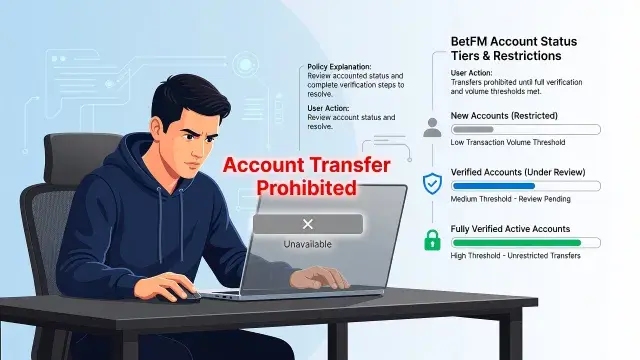
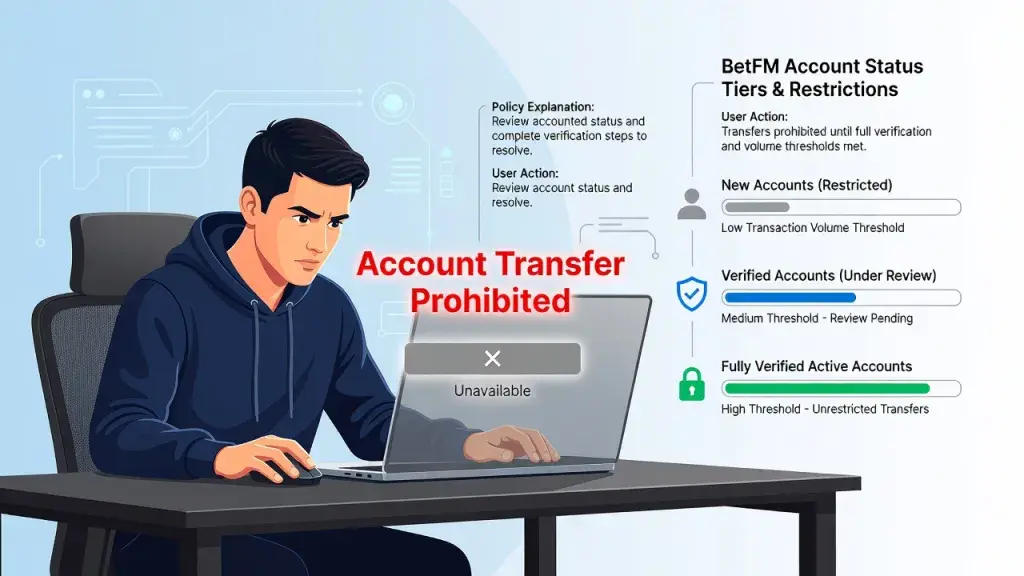
BetFM applies a layered restriction system rather than a single on/off switch. Different account states carry different transfer permissions, and knowing which tier an account falls into clarifies why a specific transfer failed.
Account Status Tiers
New accounts, verified accounts, and accounts under review each have distinct transfer capabilities. A newly created account, for instance, may be barred from any outbound transfer until a minimum activity threshold or verification step is met.
Transaction Volume Thresholds
BetFM transfer restrictions often scale with volume. Small transfers may process without friction, while larger amounts require additional verification or manual approval, since high-value transfers carry greater fraud and money-laundering risk.
Geographic and Regulatory Limitations
Licensing agreements differ by jurisdiction. An account registered in one region may face transfer limitations that don't apply elsewhere, simply because local regulation restricts how funds move across borders or between platform accounts.
- Unverified accounts: transfers typically disabled entirely
- Verified accounts under review: transfers capped or delayed
- Fully verified, active accounts: standard transfer limits apply
Why BetFM Account Transfer Blocked Notices Appear Without Warning
Users often report that a transfer worked yesterday and fails today with no visible change on their end. This isn't inconsistency - it reflects how automated risk engines reassess accounts continuously rather than at fixed intervals.
Real-Time Risk Scoring
Every transfer request runs through a scoring model that weighs recent activity, device information, and historical behavior. A single unusual login or a new device can shift an account's risk score enough to trigger a block on an otherwise routine transfer.
Backend Compliance Reviews
Compliance teams periodically audit accounts for regulatory adherence. If an account gets flagged for manual review - even for reasons unrelated to the transfer itself - outbound transfers are frozen until the review closes.
System-Wide Policy Updates
Platforms adjust their rules in response to new regulations or observed fraud patterns. A BetFM account transfer blocked notice can sometimes result from a policy change applied retroactively to accounts that previously had unrestricted transfer access.
The Prohibited Transfer Policy Explained
The prohibited transfer policy is the formal rule set governing which transfers are disallowed under any circumstance, distinct from the temporary restrictions tied to account status.
Third-Party Transfers
Almost universally, platforms prohibit transferring funds to an account that isn't registered under the same verified identity. This closes off a common avenue for money laundering and prevents disputes over ownership of funds.
Transfers Involving Flagged Accounts
If either the sending or receiving account has an active fraud flag, suspension, or pending investigation, the transfer is blocked regardless of amount or account tier. This protects the platform from being used to move funds out of an account before an investigation concludes.
Bonus and Promotional Fund Restrictions
Funds tied to promotional credit or bonus wagering requirements typically cannot be transferred until those requirements are met. This is standard across the industry and prevents users from extracting promotional value without fulfilling the associated terms.
BetFM Account Transfer Limitations by Account Type
Not every account faces the same ceiling. Limitations scale with verification depth, account age, and transaction history.
Standard Verified Accounts
These accounts typically have moderate transfer limits, sufficient for regular use but capped to reduce exposure if the account credentials are ever compromised.
High-Volume or Long-Tenured Accounts
Accounts with an established history of legitimate activity often qualify for higher transfer ceilings, since sustained good behavior lowers the calculated risk profile.
Restricted or Probationary Accounts
Accounts recovering from a prior violation or flagged incident usually operate under tightened limitations for a defined period, even after the original issue is resolved.
Step-by-Step: Resolving an Account Transfer Prohibited Error
Once the cause category is identified, resolution follows a fairly predictable path.
Confirm Verification Status First
Before contacting support, check whether identity verification, address confirmation, and payment method validation are all fully complete. This single step resolves a large share of transfer blocks without further intervention.
Review Recent Account Activity
Look for anything unusual in the past few days - a new login location, a changed payment method, or a large deposit. Identifying the likely trigger makes the support conversation faster and more targeted.
Contact Support With Specific Details
Rather than reporting "the transfer isn't working," provide the exact error message, timestamp, and transfer amount. Specific detail lets support teams locate the exact rule that fired and explain what's needed to lift it.
- Verify identity documents are current and approved
- Match payment method names to the registered account name
- Avoid repeated retry attempts, which can worsen the risk score
- Request written clarification from support on the specific restriction applied
Frequently Asked Questions
Why did my transfer work last week but fail today with no account changes on my end?
Risk scoring runs continuously, not just at account creation. A new device, login location, or unrelated compliance review can shift an account's status and trigger a block even without any visible change from the user's side.
Can I speed up resolution by submitting multiple support tickets?
No - duplicate tickets usually slow things down by splitting the case history across multiple threads. Submit one detailed ticket with the error message, timestamp, and transfer amount, then wait for a response before following up.
Does a transfer block affect my ability to deposit or withdraw?
Not necessarily. Transfer restrictions specifically govern moving funds between accounts or users, while deposits and withdrawals often follow separate rule sets. Check whether the error is transfer-specific or applies platform-wide.
Will completing identity verification immediately lift a transfer block?
Verification resolves blocks caused by incomplete KYC, but if the block stems from a flagged account or an active compliance review, verification alone won't clear it. Support confirmation is needed to identify the actual cause.
Are transfer limits the same for every user on the platform?
No. Limits scale with account tier, verification depth, and transaction history, so two verified accounts can have different transfer ceilings based on tenure and past activity.
What's the difference between a temporary restriction and a permanent prohibition?
Temporary restrictions are tied to account status and lift once conditions change, such as completing verification. Permanent prohibitions, like blocking third-party transfers, are fixed policy rules that no account status change will override.