Roughly 400 million ATMs operate worldwide, and yet a surprising number of people still hesitate at the machine, unsure whether they've pressed the right button or whether their card is about to get swallowed. The process is simple once you know it, but the small mistakes - wrong PIN entry, missed withdrawal limits, forgotten cards - happen every day, to people who use ATMs regularly.
This guide breaks down the entire process of an ATM withdrawal into clear, sequential steps, so there's no ambiguity at the machine. Whether you're doing this for the first time or you've simply never paused to think through the mechanics, you'll find the full sequence here - from inserting your card to walking away with your cash and a printed or digital receipt. For readers who want a closer look at related procedures, including how to withdraw money from a linked account through alternative methods, there are additional resources worth checking before you visit a machine for the first time.
By the end, you'll understand not just the mechanical steps, but the reasoning behind daily limits, fees, and security practices that protect your money. Withdrawing cash shouldn't be a source of stress, and it isn't once you know what's happening behind the screen.
Understanding How ATM Withdrawals Work
What Happens Behind the Scenes When You Withdraw Cash
An ATM withdrawal isn't just a mechanical dispensing of bills. When you insert your card and enter your PIN, the machine sends an encrypted request to your bank's network, verifying your account balance, checking daily limits, and confirming your identity before releasing funds. This entire exchange typically takes two to four seconds, though it feels instantaneous. The ATM itself doesn't know your balance - it queries the bank in real time, which is why a network outage or slow connection can occasionally delay a transaction.
The Difference Between Bank-Owned and Third-Party ATMs
Not all ATMs belong to your bank, and that distinction matters. Bank-owned machines usually process a withdraw cash from bank request without any surcharge, since you're using your own institution's infrastructure. Third-party ATMs - found in convenience stores, airports, or standalone kiosks - often charge an operator fee on top of whatever your bank charges for out-of-network use. Knowing which type of machine you're using before you take out money from account can save you several dollars per transaction.
Daily and Per-Transaction Withdrawal Limits
Banks impose withdrawal ceilings for security and liquidity reasons. A typical daily limit ranges from a few hundred to a couple thousand dollars, depending on your account type and the bank's internal policy. Some machines also cap the amount per single transaction, meaning a large withdrawal might require multiple attempts or a visit to a teller instead.
Step-by-Step: How to Withdraw Money From Your Bank Account at an ATM
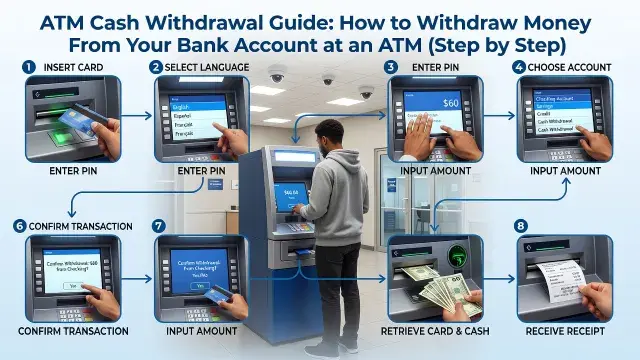
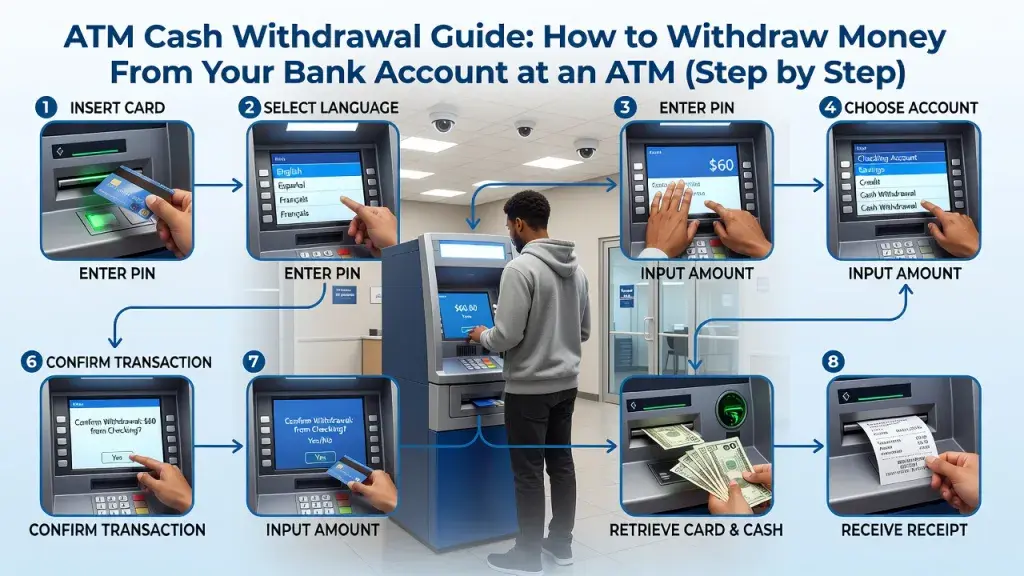
Step 1: Insert Your Card and Select Your Language
Insert your debit card into the slot, following the direction indicated by the arrow printed on the card or the machine's display. Most modern ATMs will prompt you to choose a language before proceeding, which simply adjusts the on-screen instructions for the rest of your session.
Step 2: Enter Your PIN Securely
Type your four- to six-digit PIN using the keypad, shielding your hand as you do so. This single step is the core security checkpoint of any ATM withdrawal, since it confirms you're the authorized user of the card rather than someone who simply found or stole it.
Step 3: Choose "Withdrawal" and Select the Account
Once authenticated, the machine will present a menu of options - balance inquiry, transfer, deposit, and withdrawal among them. Select withdrawal, then choose which linked account you want to draw from, typically checking or savings.
Step 4: Enter the Amount and Confirm
Input the amount you want to withdraw, sticking to denominations the machine can dispense (usually multiples of $20). Confirm the transaction, and the ATM will process the request, deduct the funds, and dispense the cash along with your card and receipt if requested.
- Check the amount displayed before confirming - errors are easier to fix before the transaction than after.
- Retrieve your card first; most machines require this before dispensing cash, precisely to prevent people from leaving it behind.
- Count your cash at the machine if privacy allows, rather than assuming the dispensed amount is correct.
Cash Withdrawal Steps for Different Situations
Withdrawing Without a Physical Card (Cardless ATM Access)
Many banks now allow cardless withdrawals through a mobile app. You generate a one-time code or use near-field communication (NFC) by holding your phone near the machine, then enter a PIN to complete the transaction. This method is increasingly common and eliminates the risk of card skimming devices reading your magnetic stripe.
Withdrawing Cash Abroad
International withdraw money at ATM transactions usually involve a currency conversion fee and sometimes a flat foreign transaction charge from your bank. The ATM will often ask whether you want the conversion calculated by the local bank or your home bank - choosing your home bank's rate is typically more favorable, since local ATM conversion rates tend to include a hidden markup.
Withdrawing With a Joint or Business Account
If you share an account, either holder can typically perform a standard withdrawal using their own card and PIN, since both are usually granted equal access. Business accounts may have stricter daily limits or require dual authorization for larger withdrawals, depending on how the account was set up.
Fees, Limits, and Costs to Know Before You Withdraw
In-Network vs. Out-of-Network Fees
Using your own bank's ATM almost always avoids fees entirely. Step outside that network, and you could face a charge from your own bank plus a separate surcharge from the ATM operator - sometimes totaling $5 or more per withdrawal. Over a year, frequent out-of-network use adds up to a meaningful, avoidable cost.
How Daily Limits Are Set and Why They Exist
Limits protect both the bank and the customer. They reduce the damage from a stolen card and manage the physical cash reserves a machine can hold. If you need to withdraw more than your daily cap allows, a teller withdrawal inside a branch is usually the workaround, since it isn't bound by the same ATM-specific restrictions.
Overdraft Risk When Withdrawing Cash
If your account balance is lower than you think, an ATM withdrawal can push you into overdraft, triggering a fee from your bank. Checking your balance before a large withdrawal - either at the machine or through your app - prevents this entirely avoidable cost.
Security Practices for Safe ATM Withdrawals
Spotting Card Skimmers and Tampered Machines
Skimming devices are thin overlays fitted onto the card slot or keypad, designed to record your card data and PIN. Wiggling the card reader before inserting your card, and checking for a loose or oddly textured keypad, are simple habits that catch most tampering attempts.
Choosing Safe ATM Locations
Machines inside a bank lobby or a well-lit, monitored location are safer than standalone kiosks in isolated spots. Late-night withdrawals in unfamiliar areas carry more risk, both from a security-camera standpoint and personal safety standpoint.
What to Do If Your Card Is Retained or a Transaction Fails
If the machine keeps your card, contact your bank immediately - most institutions can flag the transaction and arrange a replacement without holding you liable for any unauthorized use. If a withdraw money at ATM transaction fails after your account is debited, banks are generally required to reverse the charge once you report it, though this can take a few business days.
Frequently Asked Questions
What happens if the ATM shows an error but my account was still charged?
Contact your bank's customer service line as soon as possible and report the failed transaction with the date, time, and location of the machine. Most banks will investigate and reverse the charge within a few business days once the discrepancy is confirmed.
Can I withdraw cash from a bank that isn't mine without a fee?
It's possible if your bank participates in a fee-free network with certain partner banks or retailers, but otherwise expect a surcharge from the ATM operator and possibly your own bank. Checking your bank's app for nearby in-network machines before traveling avoids this cost.
Is there a limit to how much I can withdraw at an ATM per day?
Yes, virtually all banks set a daily withdrawal cap, often between a few hundred and a couple thousand dollars depending on your account type. If you need more, a branch teller withdrawal typically isn't restricted by the same limit.
What should I do if I forget my PIN at the machine?
Most banks let you reset your PIN through their mobile app, online banking portal, or by calling customer service directly. Avoid guessing repeatedly at the machine, since several failed attempts can temporarily lock your card.
Are cardless ATM withdrawals as safe as using a physical card?
Cardless withdrawals are generally considered safer in some respects, since there's no card to skim or clone at the machine. The transaction still relies on your phone's security and a one-time code or NFC connection, so keeping your device locked and updated matters just as much as protecting a physical card.
Why did the ATM only dispense certain bill denominations?
ATMs are loaded with specific denominations, usually $20 bills, and can only dispense in those increments. If you request an amount that doesn't divide evenly, the machine may round down or reject the transaction until you adjust the requested amount.