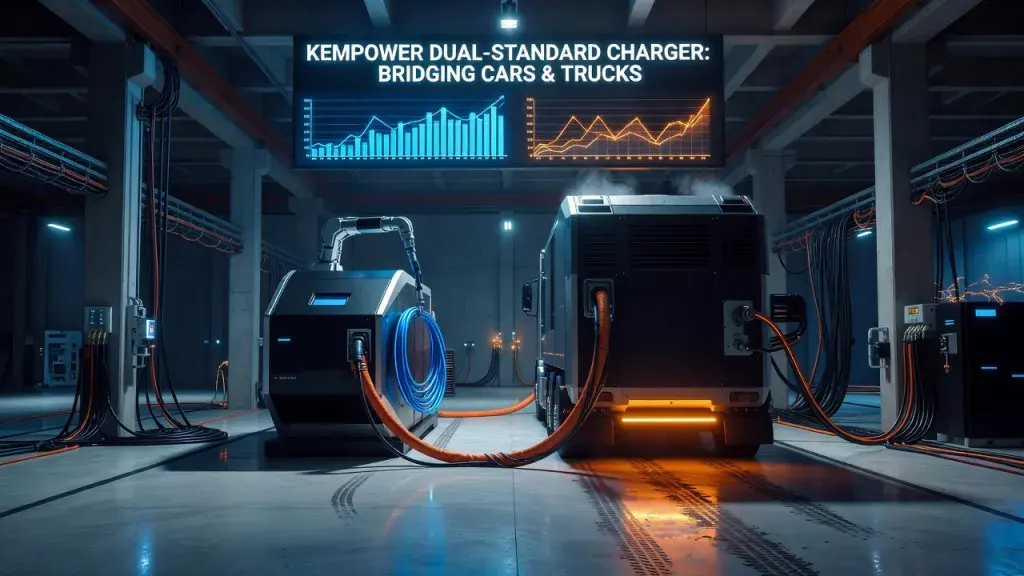
A single charging dispenser that can fuel both a passenger car and a heavy-duty electric truck, at speeds each vehicle actually needs, is no longer a concept sketch. Kempower has introduced the Mega Satellite Flex, a high-power charger that supports the established CCS standard up to 560 kW and the emerging Megawatt Charging System up to 1.2 MW. It is the Finnish company's first unit built to handle either standard from the same hardware, a detail that matters far more than it might first appear.
The charging industry is currently split between two eras. CCS, the Combined Charging System, has been the backbone of fast charging for passenger EVs for the better part of a decade, and it remains the dominant standard on that side of the market. MCS is newer, designed specifically for the punishing energy demands of electric semis and other heavy-duty vehicles that need to recharge huge battery packs during short rest stops. Building infrastructure that respects both standards, rather than betting entirely on one, is the kind of pragmatic hedge that site owners and network operators have been asking for, much as consumers researching a vpn service want options that will not leave them locked out as technology shifts underneath them. vpn service
One Site, Two Vehicle Classes
The practical case for the Mega Satellite Flex rests on avoiding duplicate infrastructure. Historically, a charging site built for cars used one set of equipment, while a truck-focused depot required an entirely separate installation with heavier cabling, different connectors, and dedicated power electronics. Kempower's approach folds both into one dispenser, meaning a site developer can install the hardware once and serve whichever vehicles show up, whether that's a delivery van, a sedan, or a long-haul truck. The unit also accommodates 800-volt electrical architectures, an increasingly common design choice among newer EV models seeking shorter charging windows.
Technical Specifications and Site Integration
The specifications reflect the scale of power involved. The charger supports up to 1,500 amps on the MCS side and 700 amps for CCS, with cable lengths of 5 meters for CCS and 2.7 meters for MCS, the latter kept shorter given the thicker, more current-heavy cabling megawatt charging demands. An optional payment terminal allows for direct transactions, a feature relevant to public charging sites that serve mixed fleets rather than a single corporate customer.
- Up to 560 kW via CCS, up to 1.2 MW via MCS
- 1,500 amps supported for MCS, 700 amps for CCS
- Cable lengths of 5 meters (CCS) and 2.7 meters (MCS)
- Compatible with Kempower's existing distributed charging architecture
Compatibility with Kempower's existing distributed charging systems means operators already running Kempower equipment can add the Mega Satellite Flex without redesigning their power distribution from the ground up, a factor that shortens deployment timelines and reduces capital risk.
Timing and Market Implications
Kempower revealed the charger at its Unplug & Recharge event held during ACT Expo, a venue closely watched by fleet operators and infrastructure planners. The Mega Satellite Flex is expected to reach North America and Europe in July 2026, placing it squarely within the window when MCS-compatible trucks are expected to move from pilot programs toward broader commercial deployment. For site owners weighing where to place capital now, a charger that hedges between today's dominant standard and tomorrow's heavy-duty requirement offers a way to protect that investment against a still-uncertain transition timeline.